
13th FOKUS Media Web Symposium
June 16–17, 2026 – Berlin
© iStock | mim.girl | Fraunhofer FOKUS
Program Overview
Please see the program overview and the detailed program below.
Sign in for the FAME newsletter to receive relevant updates on our activities. In case you want to participate as a speaker, sponsor or partner, please contact us!
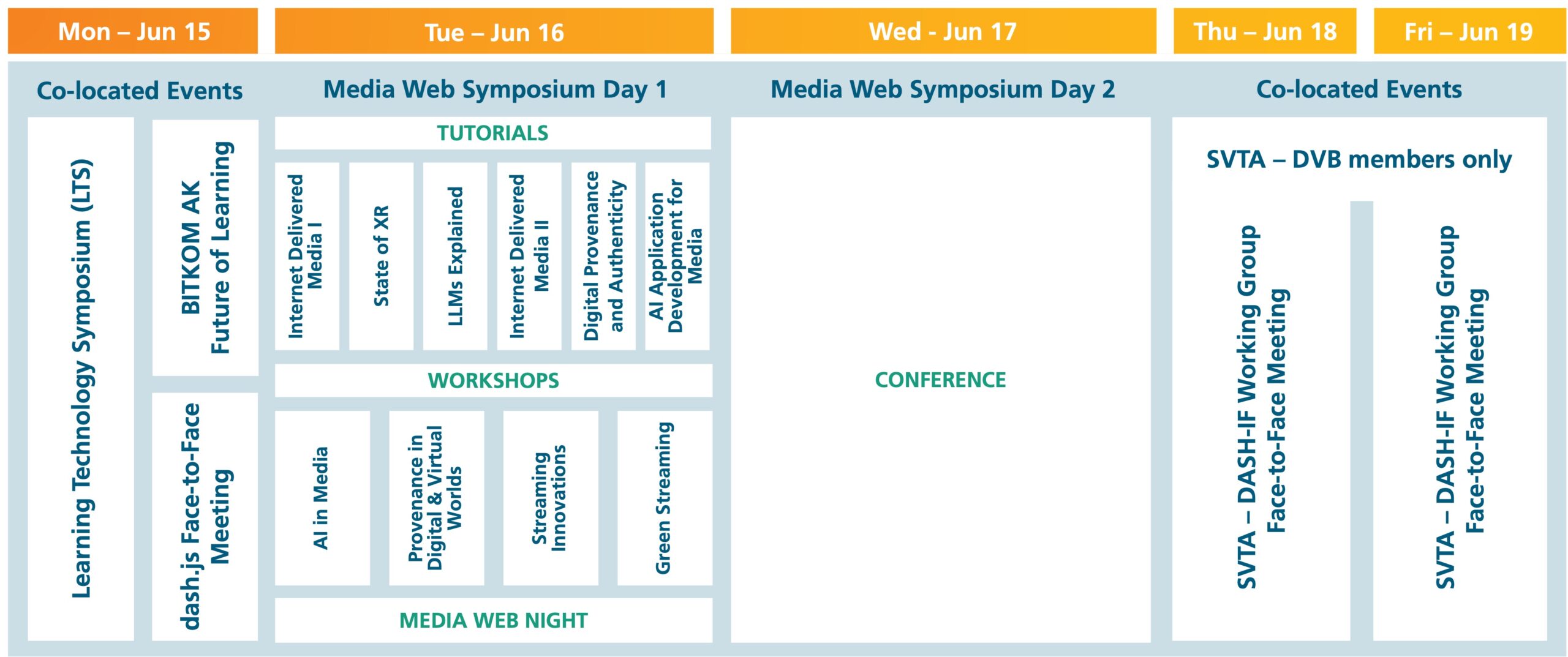
Detailed Program
We look forward to fruitful discussions, talks and presentations!
Registration
Tutorials
- Daniel Silhavy
The first part of this tutorial introduces the fundamental concepts and technologies behind internet‑delivered media. It provides an in‑depth overview of modern streaming formats and protocols, including MPEG‑DASH, HLS, CENC, CMAF, as well as relevant Web APIs such as Media Source Extensions (MSE), Encrypted Media Extensions (EME). Particular emphasis is placed on the latest features and recent developments in these technologies such as CMCD version 2, Server‑Guided Ad Insertion, and Green Streaming.
In addition, this part explores the standardization activities of key organizations shaping the streaming ecosystem, including MPEG, SVTA, CTA‑WAVE, and 5G‑MAGTopics include:
- Trending topics: Common Media Client Data (CMCD) Version 2, Server‑Guided Ad Insertion (SGAI), and Green Streaming
- Streaming formats and protocols: MPEG‑DASH, HLS, CENC, CMAF
- Web Media APIs: Media Source Extensions (MSE), Encrypted Media Extensions (EME)
- Standardization acitivities: MPEG, SVTA, CTA‑WAVE, and 5G‑MAG
Scientist and Project Manager
Fraunhofer FOKUS
- Louay Bassbouss
The field of Extended Reality (XR) is rapidly evolving, driven by advances in streaming technologies, new XR platforms, and a growing diversity of XR devices. This tutorial provides an overview of the current state of XR streaming and its increasing importance for delivering immersive experiences across headsets and emerging smart glasses.
We will begin by examining the key technological trends shaping XR streaming, including cloud and edge rendering, low‑latency networks, and adaptive streaming techniques, and discuss their implications for scalable XR content delivery. The tutorial will then explore the role of XR streaming in supporting next‑generation XR experiences, with a focus on media, interactive applications, and virtual environments.
In the context of XR platforms and devices, we will discuss how Android XR and recent developments in Spatial Computing are influencing XR streaming architectures. In addition, the tutorial will provide an update on the latest XR devices, with particular emphasis on smart glasses and display‑enabled wearables, such as Meta Ray‑Ban Display glasses and upcoming Android XR‑based devices including Samsung Galaxy XR.
Topics include:
-
Tech Trends in XR Streaming: cloud and edge rendering, low-latency networks, and hardware
-
Next-Gen Immersive Experiences: delivery of high-fidelity media, interactive applications, and virtual environments
-
XR Platforms & Architectures: Android XR and recent developments in Spatial Computing
-
Evolving Device Landscape: latest hardware trends, including smart glasses, and display-enabled wearables
Senior Project Manager R&D
Alexander ZoubarevFraunhofer FOKUS
Research Associate
Fraunhofer FOKUS
-
- Christopher Krauss
As AI becomes increasingly central to media workflows, understanding how modern models actually work is essential. This tutorial provides a clear, accessible, and technically grounded introduction to contemporary AI systems — with a special focus on neural networks, Transformer models, and Large Language Models (LLMs).
We unpack the mechanics behind today’s generative AI: how models process language, how attention works, what happens during training and inference, and why Transformers are so effective. Through intuitive explanations, visual breakdowns, and simplified examples, participants will gain a solid conceptual understanding of how modern AI systems operate “under the hood.”
Topics include:
- AI & Machine Learning Basics: Core concepts, model families, training principles
- Vectorization: Architecture, embeddings, tokenization, optimization
- The Transformer Model: Attention mechanisms, encoder/decoder structures, masking
- Capabilities & Limitations: Bias, hallucinations, safety constraints, model weaknesses
- Looking Ahead: Trends such as multimodal models and mixture of experts
This tutorial is ideal for participants who want to understand how modern AI and LLMs function.
Media & Data Science Lead
Marc GhanimeFraunhofer FOKUS
Research Associate
Bach DoFraunhofer FOKUS
Research Associate
Fraunhofer FOKUS
- Daniel Silhavy
The second part of the tutorial focuses on advances in low-latency streaming delivery, with particular emphasis on Low Latency Low Delay (L3D) DASH and Media over QUIC. It introduces the underlying principles, architectural considerations, and practical implications of both adaptive streaming technologies with emerging transport protocols designed for improved latency and efficiency.
Whenever possible, these concepts are illustrated through short live demonstrations, with a particular focus on playback using the DASH reference player dash.js and the FAMIUM MoQ player.
Topics include:
- Low Latency Low Delay (L3D) DASH: concepts, mechanisms, and implementation considerations
- Media over QUIC: architecture, transport features, and integration with adaptive streaming
- Web Media APIs and protocols: Media Source Extensions (MSE), Web Transport API, QUIC
- Live demonstrations: dash.js and FAMIUM MoQ
Scientist and Project Manager
Louay BassboussFraunhofer FOKUS
Senior Project Manager R&D
Fraunhofer FOKUS
- Naomi Schoppa
As digital media becomes increasingly tampered with, AI‑generated, and rapidly distributed, ensuring trust in content is more critical than ever. This tutorial offers a clear and technically grounded introduction to Provenance & Authenticity — why they matter, how they work, and how modern standards help verify the origin and integrity of media.
Drawing on real‑world examples and intuitive explanations, the session demystifies how provenance metadata is created, maintained, verified, and protected across the media lifecycle. Participants will learn why misinformation, deepfakes, and content manipulation have become systemic challenges — and how emerging technologies address them.
Topics include:
- Why Provenance Matters Today: The rise of misinformation, disinformation, deepfakes, and synthetic media — and how trust in digital ecosystems is eroding.
- Core Concepts of Provenance & Authenticity: What provenance means in a media context: origins, editing history, ownership, and the “trust trail” of content.
- Foundations of Media Provenance: How metadata, signatures, and provenance chains capture how content evolves during production and publishing.
- Technical Underpinnings: How provenance information is structured, validated, and linked.
- Challenges in Modern Media Landscapes: What makes trustworthy content verification difficult in distributed media environments.
Ideal for participants seeking a conceptual foundation in media provenance, this tutorial bridges the gap between why provenance is essential and how technical mechanisms ensure authenticity.
Research Associate
Stefan PhamFraunhofer FOKUS
Senior Project Manager
Fraunhofer FOKUS
- Christopher Krauss
Building on the foundational understanding from the first tutorial, this session focuses on how to develop AI‑powered applications tailored to the media domain. It covers hands‑on methods, architectural approaches, and best practices for building robust, production‑ready AI systems.
Participants learn how to work effectively with LLMs — from prompting and orchestration to fine‑tuning and advanced retrieval techniques (RAG). We explore how to integrate multimodal models into production workflows, build intelligent assistants, and design agent‑based pipelines capable of handling complex tasks.
Topics include:
- LLM-Based Application Development: Prompting strategies, evaluation, orchestration
- Fine‑Tuning & Customization: Parameter‑efficient methods, domain adaptation
- Retrieval‑Augmented Generation (RAG): Document pipelines, vector databases, retrieval workflows
- AI Agents: Tool use, multi‑step reasoning, automation patterns
- Multimodal AI: Vision‑language models, video analysis, interactive media chatbots
- Hands‑On Use Cases:
- Intelligent document‑based chatbots
- Search & recommendation assistants
- Video‑based conversational agents
- Interview bots for expert knowledge capture
- Authenticity & Security: C2PA, provenance, compliance, responsible AI guidelines
This tutorial is designed for developers, media technologists, innovation leads, and anyone creating AI-driven applications in media environments.
Media & Data Science Lead
Bach DoFraunhofer FOKUS
Research Associate
Marc GhanimeFraunhofer FOKUS
Research Associate
Fraunhofer FOKUS
Lunch Break
LUNCH, DEMOS & EXHIBITIONS
Workshops
AI in Media
13:30 - 14:30 | Session 1
Robin RabeVibe Coding: Superpower or Footgun? A Hands-On Reality Check
Solution Engineer
Microsoft
Jörg MüllerAI Strategy Consultant, Agent & Skill Design, Claude Code Expert
Co-Intelligence.ai
Sören HübnerCo-Founder and CTO
SONALAB GmbH
15:00 - 16:00 | Session 2
Martin PrinsHead of Product
Media Distillery
Kemal GorgülüChief Technology Officer
Sebastian SiepeARTE
CTO
EINBLIQ.IO
Alexander WogeCEO / Founder
Nordic AI Solutions
16:30 - 18:00 | Session 3
Ralf-Dieter WagnerHead of Specialists and GenAI
Lajos LangeAmazon Web Services
EMEA Leader Enterprise Technologists | Enterprise Solutions Architecture
AWS
Kenny MárioCo-Founder & AI-Strategist
Ludger Brechmanntaktlos GmbH
Co-Founder & AI-Engineer
taktlos GmbH
Alan AngSenior Partner Manager
Stefan BaackWikimedia Deutschland
AI and Data Governance Researcher
Self-employed
Provenance in Digital & Virtual Worlds
13:30 - 14:30 | Session 1
Enrico EntschewPrincipal Industrial Standardization and Compliance
D-Trust
Anna SüßCommunity Manager CORRECTIV.Faktenforum
CORRECTIV
Dimitris DrandakisCo-Founder | Chief Technology Officer
Nostos Online & Mediastalker
15:00 - 16:00 | Session 2
Alexander LeschinskyCo-Founder & CEO
G&L Systemhaus
Patrice HirtzlinSenior Scientist
InterDigital
François DaoustMedia and Entertainment Champion
W3C
16:30 - 18:00 | Session 3
Valentijn SiebrandsStreaming Solution Manager
Unified Streaming
Nicolas LevyCTO
Pablo FloresQualabs
VP of Engineering
Qualabs
James HynardBusiness Development Manager – Content Security & Distribution
Castlabs
Streaming Innovations
13:30 - 14:30 | Session 1
Jan GänslerVideo Solutions Consultant – gTech EMEA
Daniele ConcaGoogle Germany GmbH
Video Solutions Consultant – gTech EMEA
Google Germany GmbH
Torbjörn EinarssonStreaming Media Expert
Eyevinn Technology
Vincent RichardSenior R&D Engineer
Broadpeak
15:00 - 16:00 | Session 2
Frédéric GabinDirector Mobile Technology & Standards, Dolby Labs. Chair of 5G-MAG, Chair of 3GPP SA4 MBS SWG
Dolby
Jordi J. GimenezHead of Technology
5G-MAG
Max BläserSenior Video Coding Engineer R&D
Mainconcept GmbH
16:30 - 18:00 | Session 3
Oliver LietzCEO/Founder
Luiza Sadowskananocosmos
Software Developer and Developer Advocate
nanocosmos
Ali C. BegenProfessor
Zafer GurelOzyegin University
Software Engineering Director
Constructor Tech
Alex GiladiPrincipal Architect
Netflix (OpenConnect)
Yuriy ReznikCTO
Streaming Labs, Ltd
Green Streaming
Chair:Robert Seeliger13:30 - 14:30 | Session 1
Robert SeeligerInnovation Principal
Fraunhofer FOKUS
Peter PogrzebaSenior Project Manager
Deutsche Telekom Innovation Laboratories
Anna-Maria ZeußelSolution Architect
Friederike FluitLOGIC media solutions GmbH
Solution Architect
LOGIC media solutions GmbH
15:00 - 16:00 | Session 2
Annette WilsonHead of Research Projects
Rundfunk Berlin-Brandenburg
Maria ZeitzLead Project Manager
KlimAktiv gGmbH
Amelie JakobProduct Owner Big Screen Application
ZDF
16:30 - 18:00 | Session 3
Franck AumontPrincipal Engineer, Video Architect
InterDigital
Francois RoloffCEO and Co-Founder
Pyure.ai
Benjamin SchwarzFrom Estimates to Evidence: The GoS Journey and What’s Next
President
Greening of Streaming
Media Web Night
Media Web Night
The Media Web Night will take place at the BRLO BRWHOUSE
Rebecca H. SirmonsKeynote: Houston, We Have a Stream – The NASA+ ARTEMIS II Mission Streaming Experience
General Manager
NASA+
08:30
REGISTRATION, WELCOME COFFEE
09:30
Conference Opening & Keynote
Robert SeeligerConference Opening by MWS Chairs
Innovation Principal
Christopher KraussFraunhofer FOKUS
Media & Data Science Lead
Fraunhofer FOKUS
Sergey FedorovDirector of Engineering, New Initiatives
Netflix
10:15
Session 1: AI-Driven Media and the Return of Live
Chair:Jörn KriegerAlexander HeidlerSenior Account Executive Media and Telecommunication
Microsoft
Emily DubsHead of Technology
DVB
10:45
Exhibition Partner Pitches
by Backscreen, Cloud Germany, Ericsson, EZDRM, Interdigital, LOGIC media solutions, Nanocosmos, Sony Europe, Verimatrix
11:05
COFFEE BREAK, NETWORKING, DEMOS & EXHIBITION I
11:30
Session 2: Scaling Reliable Streaming
Chair:Antonella LorenzettiMaria MalinkowitschDirector Product Management
Verimatrix
Will LawChief Architect, Cloud Technology Group
Akamai
Glenn DeenFellow
Comcast NBCUniversal
12:30
LUNCH, NETWORKING, DEMOS & EXHIBITION
14:00
Session 3: Future Media Pipelines
Chair:Susi AltrichterLukasz LitwicSenior Research Manager
Ericsson
Jan OuttersDirector Technology & Standards
Ateme
Thomas WillRegional Sales Head DACH & NL – Imaging Products and Solutions
Jin KoideSony
News & Production Worflow
Sony
Anna-Maria ZeußelSolution Architect
Daniel RobinsonLOGIC media solutions GmbH
Product Manager
Matrox
Thomas StockhammerSenior Director Technical Standards
Qualcomm Technologies
15:15
COFFEE BREAK, NETWORKING, DEMOS & EXHIBITION II
15:45
Session 4: The Streaming Product Playbook
Chair:Robert SeeligerFalk HofmannPartner
Rödl IT Secure GmbH
Bernd RieflerFounder & CEO
veed analytics
Sandra GroßDirector Product & Technology
Funke Channels
Jon PiesingDirector Standardisation TP Vision and Vice-Chair HbbTV Association
TP Vision
Oliver KochManaging Director Qvest OTT
Qvest Engage
17:30
Conference Closing