
13th FOKUS Media Web Symposium

June 16–17, 2026 – Berlin

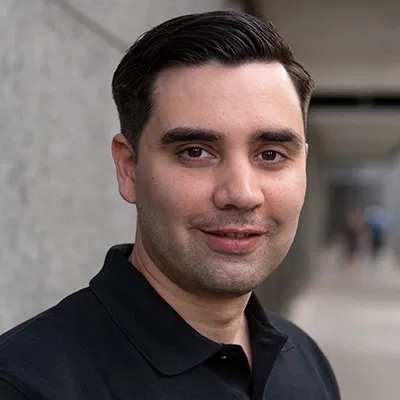
Daniel Silhavy

Scientist and Project Manager

Fraunhofer FOKUS

Daniel Silhavy is a scientist and project manager at the business unit Future Applications and Media (FAME) of the Fraunhofer Institute for Open Communication Systems (FOKUS). He received his Master’s degree with the completion of his thesis “Ad Insertion in MPEG-DASH” at Fraunhofer Institute for Open Communication Systems (FOKUS) in 201. Daniel is the lead developer of the dash.js project and the development coordinator for the 5G-MAG Reference Tools.

His main area of expertise includes adaptive bitrate (ABR) streaming focusing on MPEG-DASH, Digital Rights Management (DRM), 5G media streaming and video-encoding. Daniel is actively contributing to standardization work done in DASH-IF and CTA-WAVE. Moreover, Daniel is giving lectures at the Technical University of Berlin and is supervising Bachelor and Master theses.  As part of his work in dash.js and the 5G-MAG Reference Tools, Daniel has developed in-depth knowledge in the field of media streaming and related specifications (ISO,3GPP,DVB,DASH-IF) and technologies, C++ programming, as well as web-based technologies and APIs such as HTML, JavaScript, node.js,  MSE and EME.

Daniel has published various technical papers covering topics around ABR media delivery and streaming analytics.

  • 13:30 - 14:30 | Session 1

    Jan Gänsler

    Video Solutions Consultant – gTech EMEA

    Google Germany GmbH

    Daniele Conca

    Video Solutions Consultant – gTech EMEA

    Google Germany GmbH

    Torbjörn Einarsson

    Streaming Media Expert

    Eyevinn Technology

    15:00 - 16:00 | Session 2

    Frédéric Gabin

    Director Mobile Technology & Standards, Dolby Labs. Chair of 5G-MAG, Chair of 3GPP SA4 MBS SWG

    Dolby

    16:30 - 18:00 | Session 3

    Oliver Lietz

    CEO/Founder

    nanocosmos

    Luiza Sadowska

    Software Developer and Developer Advocate

    nanocosmos

    Ali C. Begen

    Professor

    Ozyegin University

    Zafer Gurel

    Software Engineering Director

    Constructor Tech

    Alex Giladi

    Principal Architect

    Netflix (OpenConnect)

  • The second part of the tutorial focuses on advances in low-latency streaming delivery, with particular emphasis on Low Latency Low Delay (L3D) DASH and Media over QUIC. It introduces the underlying principles, architectural considerations, and practical implications of both adaptive streaming technologies with emerging transport protocols designed for improved latency and efficiency.

    Whenever possible, these concepts are illustrated through short live demonstrations, with a particular focus on playback using the DASH reference player dash.js and the FAMIUM MoQ player.

    Topics include:

    • Low Latency Low Delay (L3D) DASH: concepts, mechanisms, and implementation considerations
    • Media over QUIC: architecture, transport features, and integration with adaptive streaming
    • Web Media APIs and protocols: Media Source Extensions (MSE), Web Transport API, QUIC
    • Live demonstrations: dash.js and FAMIUM MoQ
    Daniel Silhavy

    Scientist and Project Manager

    Fraunhofer FOKUS

    Louay Bassbouss

    Senior Project Manager R&D

    Fraunhofer FOKUS

  • The first part of this tutorial introduces the fundamental concepts and technologies behind internet‑delivered media. It provides an in‑depth overview of modern streaming formats and protocols, including MPEG‑DASH, HLS, CENC, CMAF, as well as relevant Web APIs such as Media Source Extensions (MSE), Encrypted Media Extensions (EME). Particular emphasis is placed on the latest features and recent developments in these technologies such as CMCD version 2, Server‑Guided Ad Insertion, and Green Streaming.
    In addition, this part explores the standardization activities of key organizations shaping the streaming ecosystem, including MPEG, SVTA, CTA‑WAVE, and 5G‑MAG

    Topics include:

    • Trending topics: Common Media Client Data (CMCD) Version 2, Server‑Guided Ad Insertion (SGAI), and Green Streaming
    • Streaming formats and protocols: MPEG‑DASH, HLS, CENC, CMAF
    • Web Media APIs: Media Source Extensions (MSE), Encrypted Media Extensions (EME)
    • Standardization acitivities: MPEG, SVTA, CTA‑WAVE, and 5G‑MAG
    Daniel Silhavy

    Scientist and Project Manager

    Fraunhofer FOKUS